Welcome to Senator Bill Cunningham Legislative Website
Cunningham formalization of mobile IDs is now law
- Details
- Category: Latest
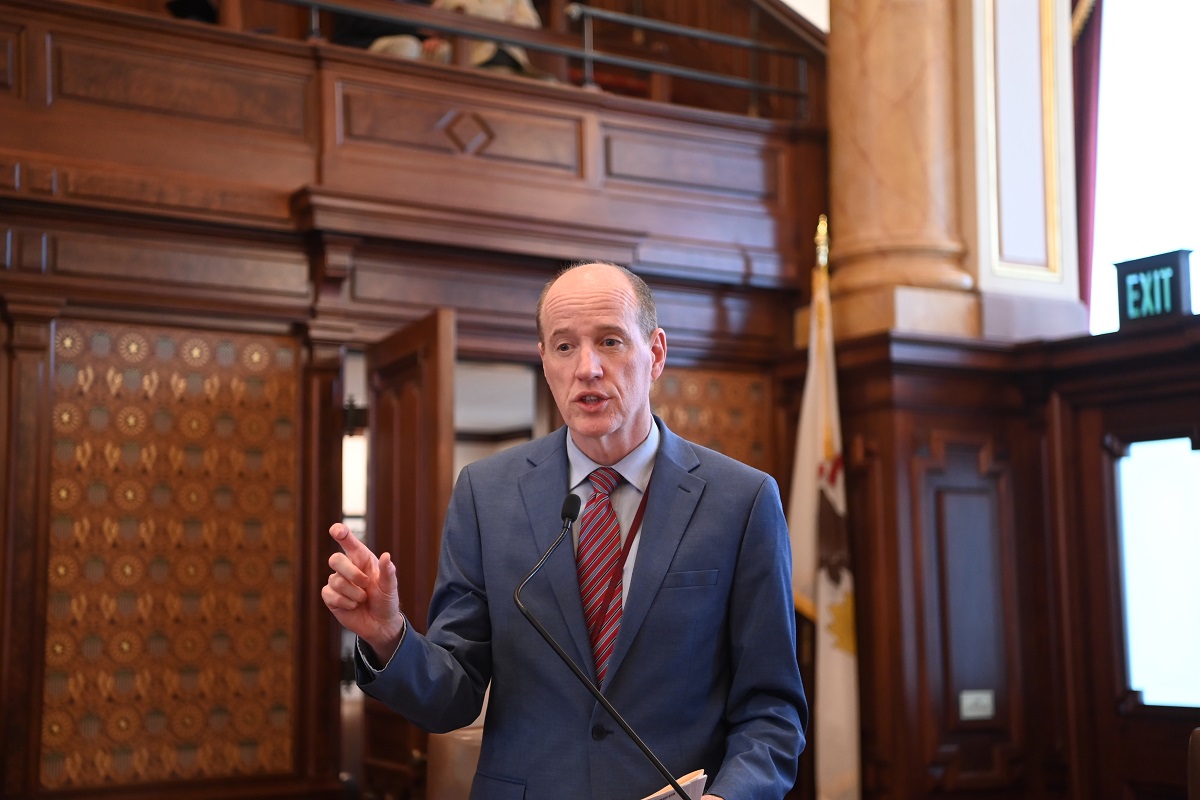
SPRINGFIELD – State Senator Bill Cunningham’s legislation to formalize mobile IDs and protect personal devices has become law.
“More and more of our personal information is digitized and contained within our personal devices, which has made many of us hesitant to hand over an unlocked phone to anyone,” said Cunningham, a Democrat who represents portions of Chicago and the Southwest Suburbs. “No one should be required to hand over such a precious piece of personal privacy just to prove their identity.”
The law was an initiative of Secretary of State Alexi Giannoulias and updates state law to align terminology and requirements related to mobile identification, ensuring clarity and consistency as digital ID technology becomes more widely used. In addition to formalizing mobile IDs, the law will prohibit any relying party, including law enforcement, from physically taking a person’s phone to verify a mobile ID. Making certain that individuals maintain control of their personal devices during the verification process.
“Handing your phone over, even to the police, risks exposing private pictures or intimate details of one's life, and people shouldn’t have to risk that level of exposure just to show identification,” said Cunningham. “With this law, we are ensuring that mobile IDs are used in a way that protects both privacy and security for people across our state.”
Senate Bill 3449 was signed into law Friday and takes effect immediately.
Cunningham law expands opportunities for deputy sheriff recruitment
- Details
- Category: Press Releases
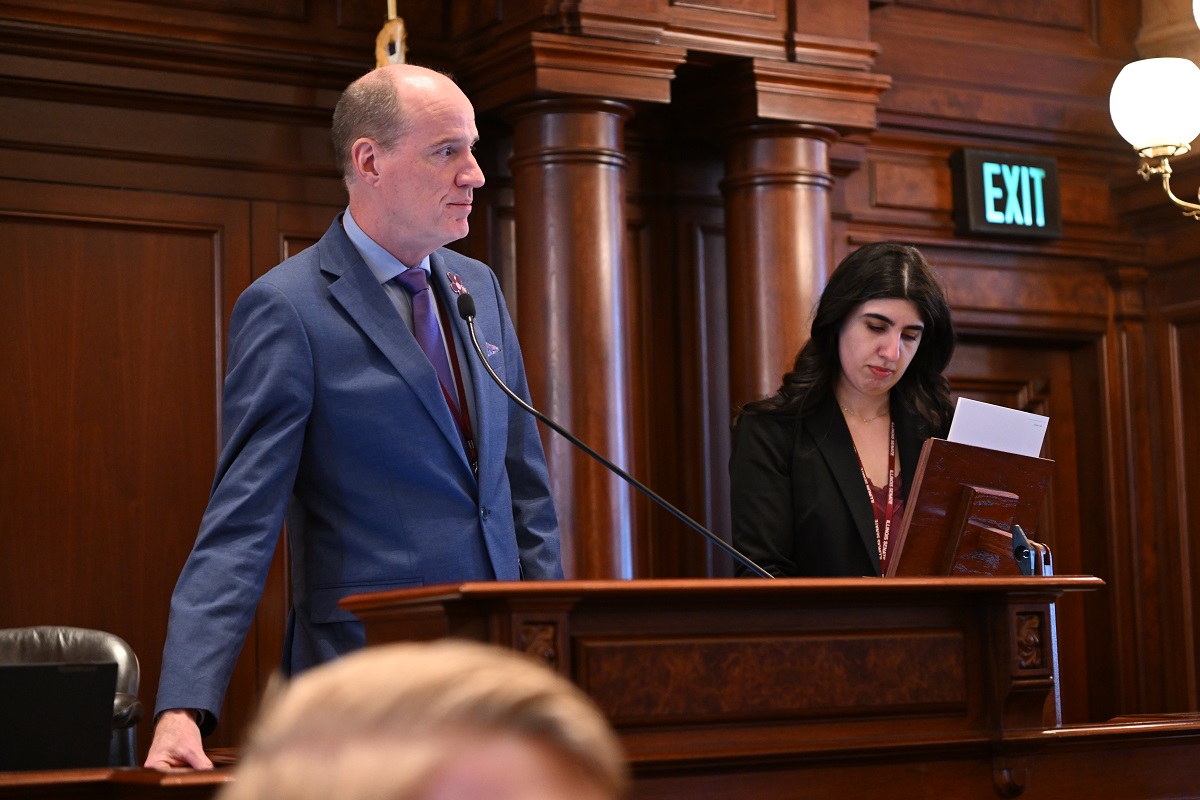
SPRINGFIELD – State Senator Bill Cunningham’s measure to help law enforcement agencies recruit and retain qualified deputy sheriffs has become law.
“As we face a shortage of police officers in our state, we have formed a program to help foster groups of young people into qualified public servants,” said Cunningham a Democrat who represents portions of Chicago and the Southwest Suburbs. “This will not only help address the shortage but also ensure that our future police officers are ones our communities can count on for their safety.”
Under the new law, the state will maintain the current minimum age requirement of 21 years old for county police officers, while allowing individuals to serve beginning at age 20 if they have completed two years of law enforcement studies at an accredited college or university. The measure will also allow correctional officers and full-time deputy sheriffs not employed as county police officers to be appointed beginning at age 18.
Furthermore, county police officers would continue to serve a probationary period of at least 12 months. Correctional officers and full-time deputy sheriffs not employed as county police officers would serve a 15-month probationary period.
“Public safety is our top priority. This isn’t a fast track to get young people into the police system,” said Cunningham. “Rather, it gives our departments the flexibility to choose candidates who are young and looking to get involved in law enforcement.”
Senate Bill 1700 was signed into law Thursday.
Cunningham’s clean energy development for public schools becomes law
- Details
- Category: Press Releases

SPRINGFIELD – State Senator Bill Cunningham’s Senate Bill 3273 that clears the way for schools to develop solar energy projects has become law.
“With energy prices on the rise, our schools need every avenue to cut costs,” said Cunningham, a Democrat who represents portions of Chicago and the Southwest Suburbs. “By streamlining the process we are making it more convenient for schools to make the switch to a clean energy alternative.
Under the new law electric utilities would be required to complete interconnection-related evaluations, reviews and screenings within 30 days after determining that a request is complete. Public school projects would also bypass the standard interconnection queue, allowing them to move forward more quickly.
Cunningham to host Mobile DMV in Alsip
- Details
- Category: District Events
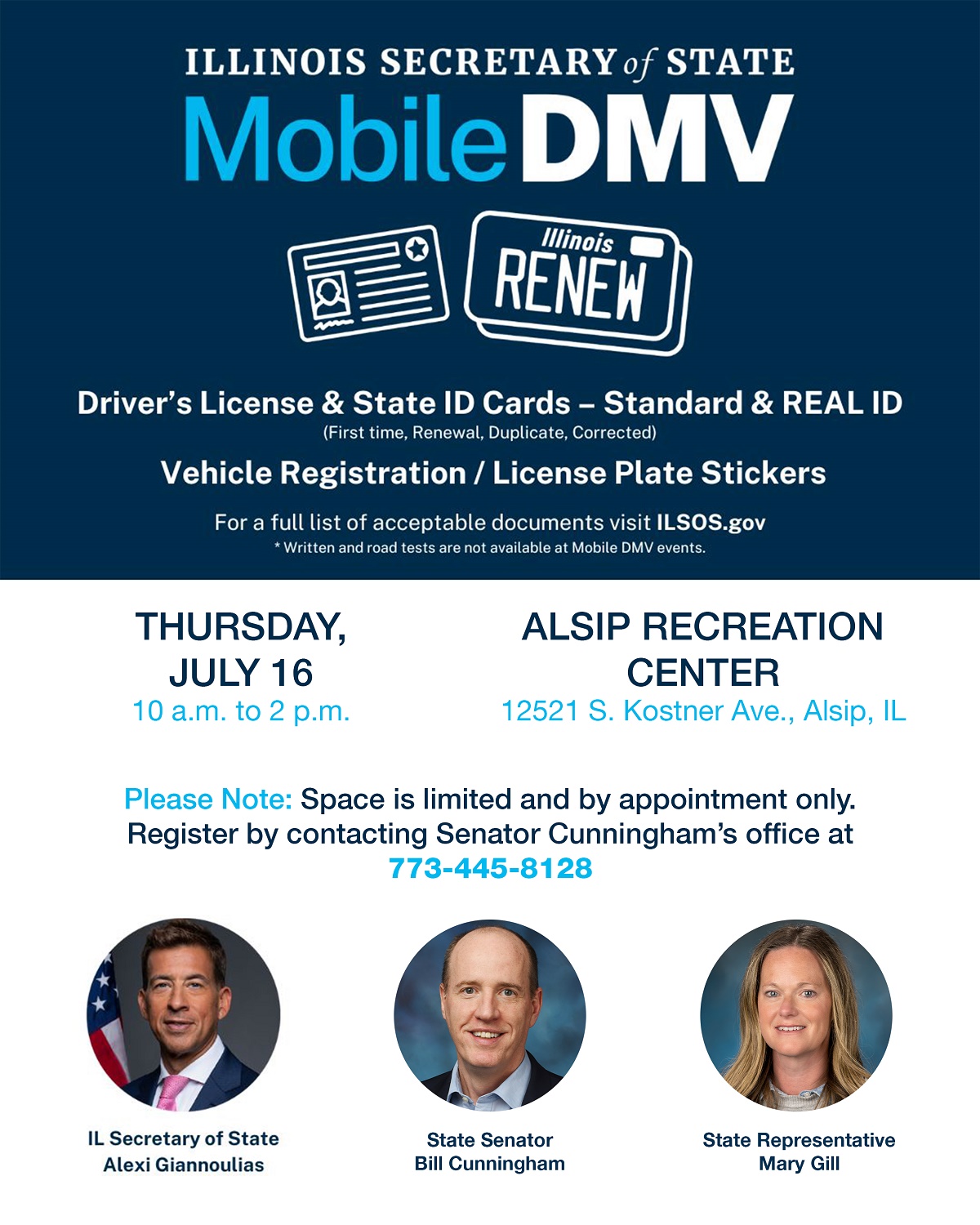
ALSIP – State Senator Bill Cunningham is partnering with State Representative Mary Gill and the Illinois Secretary of State to offer Alsip residents a chance to renew their driver’s licenses, purchase license plate stickers and more.
“Mobile DMV events provide a convenient way for community members to access vehicle services directly and swiftly,” said Cunningham, a Democrat who represents portions of Chicago and the Southwest Suburbs. “By making these services more available, we are cutting wait times and providing the necessary guidance to get you back out on the road with what you need.”
The event will be held Thursday, July 16 from 10 a.m. to 2 p.m. at the Alsip Recreation Center located at 12521 S. Kostner Ave. The mobile unit operates like a driver services facility and offers driver’s license and state ID renewals, REAL ID processing, vehicle registration stickers, organ donor registration and more. Certain services will require documentation and applicable fees, which can be found at www.ilsos.gov.
Space is limited and by appointment only. People can register for the event by contacting Cunningham’s office at 773-445-8128.
More Articles …
Page 1 of 113
Welcome
Thank you for visiting my website. I am proud to serve as the State Senator from Illinois’ 18th District, representing sections of Worth, Palos, and Orland Townships in the Southwest Cook County suburbs and the neighborhoods of Mount Greenwood, Beverly, Morgan Park and Auburn-Gresham in Chicago.
I hope you’ll find this site a useful resource to stay informed about our district and my actions in Springfield. Please contact either of my offices with questions or ways I can better serve you.
It is my honor to represent you in Springfield.
Sincerely,
Bill Cunningham
President Pro Tempore
State Senator, 18th Senate District

Follow Sen. Cunningham


eNewsletter Signup
Contact Info
Springfield Office:
Senator 18th District
325-G Capitol Building
Springfield, IL 62706
(217) 782-5145
(217) 782-2115 FAX
District Offices:
10400 S. Western Ave.
Chicago, IL 60643
(773) 445-8128
(773) 672-5143 FAX