
Press Releases
- Details
- Category: Press Releases
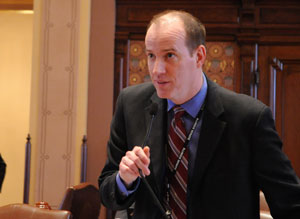 An effort to expand and preserve open lands in suburban Cook County was approved by the Illinois State Senate, thanks to a bill sponsored by newly elected Senator Bill Cunningham (D - 18th Dist.) Senate Bill 1499 gives the Cook County Forest Preserve District the power to acquire land by easement, which will enable the district to enter into voluntary agreements with businesses, utilities and local governments to acquire patches of open land and incorporate them into the Forest Preserve green belt.
Under current law, every other forest preserve district in the state of Illinois can acquire land by easement. But Cook County has to purchase any land it acquires, which creates high costs for tax payers and limits the expansion of the Cook County Forest Preserve. If Cunningham's bill becomes law, the county will be able to expand its Forest Preserve for virtually no costs through the easement process.
“Cook County is one of the most urbanized counties in the nation. With this legislation, there will be a stronger effort to create and preserve open space,” said Cunningham. "Protecting and expanding Forest Preserves and park land will always be among my top priorities in the General Assembly."
Cunningham's senate district stretches across the Southwest suburbs and Southwest side of Chicago and includes some of Cook County's largest tracks of Forest Preserve in Palos and Orland Township.
- Details
- Category: Press Releases
In an effort to ensure students spend more time learning and less time taking tests, State Senator Bill Cunningham (D-Chicago) is sponsoring legislation to cap the number of standardized tests Chicago Public Schools administer each school year.
Senate Bill 2156 limits schools to four standardized tests per year. Cunningham filed the legislation after hearing from teachers and parents in his district who feel too much of the school day is being spent preparing for and taking standardized tests. Cunningham is a Chicago Public School parent and a former member of the Local School Council for Sutherland School in Beverly.
"There is too much emphasis on standardized tests scores that do not always adequately reflect the learning abilities and achievements of students." Cunningham said. "What's more, testing is very costly to schools. That money could be better spent elsewhere.”
Currently, Chicago Public Schools’ calendar includes two full weeks of testing and 10 full school days of preparation.
“Standardized testing has an important role to play in the education process, but testing students more than four times a year becomes too disruptive to the regular curriculum,” said Cunningham.
Other states are taking action to lessen high stakes testing. For example, the Texas House of Representatives “zeroed-out” standardized test funding in its budget recommendations.
- Details
- Category: Press Releases
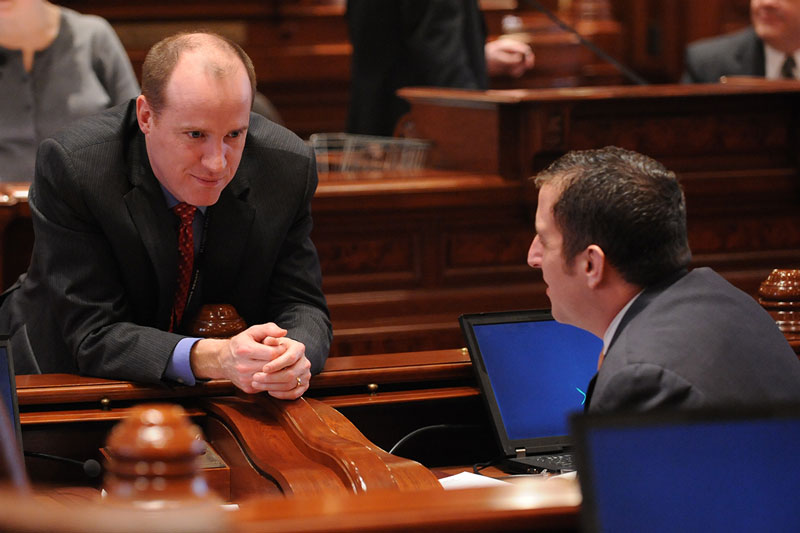 “Illinois could potentially save $105 million if we use the federal funding that is being offered to us. We would be foolish to let these federal dollars go to waste, especially when we have our own financial troubles. In a few short months the legislature will need to craft a budget and the savings will come in handy,” said State Senator Bill Cunningham (D- Beverly).
Key components of Senate Bill 26:
- All adults with incomes at or below 138 percent of the Federal Poverty Limit ($15,415 for an individual) will be able to enroll in Medicaid starting January 1, 2014. Currently, adults are eligible for Medicaid only if they have disabilities or care for dependent children.
- The federal government will reimburse Illinois for 100 percent of the costs of covering these newly eligible enrollees through 2017.
- The reimbursement rate will decrease gradually after 2017 but stay at 90 percent after 2020.
- If the federal government fails to reimburse the state at 90 percent or above, the newly eligible clients will become ineligible; Illinois will not be stuck with the bill.
Expected benefits include:
- Access to routine, coordinated care for 342,000 low-income adults
- Fewer unnecessary and uncompensated emergency room visits
- An influx of $1.1 billion in federal dollars in the first year and more than $12 billion in federal funds in the first eight years of the expansion
- Job creation in the health care sector
- $105 million in annual savings to the state as federal funds replace state expenditures on mental health, HIV/AIDS drugs and other areas of spending
- A reduction in the burden on hospitals and local government currently caring for the uninsured
- Better preventive care and mental health care for a vulnerable segment of the population
- Details
- Category: Press Releases
State Senator Bill Cunningham (D-Chicago) is sponsoring legislation to allow students with disabilities the opportunity to receive physical education credit if they participate in outside athletic programs.
Under current state law, high school students who participate in interscholastic athletic programs can receive waivers that allow them to skip P.E. classes. But Illinois students who have physical and developmental disabilities can't take advantage of such waivers because the high schools they attend rarely offer athletic programs designed for students with disabilities.
“We can’t treat some students differently than others. If student athletes can get P.E. waivers, students with disabilities who participate in athletic programs should be able to get P.E. waivers, too,” Cunningham said.
Parents of a student with disabilities brought this idea to the senator because their child participates in sports outside of school, and they believe he should have the same right to a P.E. waiver as other children.
If Cunningham's bill becomes law, students with disabilities who participate in athletic programs outside of school could apply to their local school board for a P.E. waiver. A number of sports programs could qualify for the waiver, including wheelchair basketball, sled hockey, the Special Olympics and many others.
“I want people to know my door is always open, and I encourage my constituents to bring me ideas for legislation,” Cunningham said.
- Details
- Category: Press Releases
Senator Bill Cunningham (D-Chicago) is sponsoring legislation to provide more funds for the Chicago Police and Fire pensions by using any newly established gaming revenue generated by a Chicago casino.
Senate Bill 1564 will deposit a minimum of 20% of all proceeds collected by gaming revenue in the City of Chicago into each the Chicago Police and Fire department pension funds.
“Should the General Assembly grant the City of Chicago the ability to open a casino, a badly needed source of revenue will become available. It would be wise for the city to use a portion of that revenue to address its most pressing financial issue—funding pensions for our public safety workers,” Cunningham said.
The Chicago Police and Fire pension funds are among the worst funded in the state. In addition to years of government underfunding, the Police and Fire pensions have been negatively impacted because Chicago public safety employees are not part of the workers’ compensation system. As such, the police and fire pension funds are drained of millions of dollars to pay officers and firefighters who have been injured on duty. No other government pension funds are as dramatically affected by disability payouts.
"Because the Police and Fire Funds have this additional drain on their financial resources, they need a new, additional source of revenue to make up the difference," Cunningham said. "Tapping casino revenue is the best potential solution to this underfunding problem."
- Details
- Category: Press Releases
Governor Pat Quinn spoke to the 98th General Assembly this week in his annual State of the State Address. Senator Bill Cunningham reacted to the 38-minute speech shortly afterward.
- Details
- Category: Press Releases
Senator Bill Cunningham (D-Chicago) is helping to spread awareness of heart disease, the number one killer of men and women here in Illinois.
“The least I can do is wear red today to show my support for spreading awareness of heart disease,” said Sen. Cunningham. “Not everyone knows that heart disease is the number one killer of both men and women here in Illinois. My hope is that women and men will become more informed of the risk factors of heart disease, and that more lives will be saved because of this effort to increase awareness.”
Legislators and statewide elected officials were asked to wear red today in support of the American Heart Association's Go Red For Women movement by the Conference of Women Legislators.
Sen. Cunningham will be wearing a red tie to show his support.
- Details
- Category: Press Releases
Senator Bill Cunningham (D-Chicago) is one of 15 newly-elected General Assembly members who will comprise Lt. Gov. Sheila Simon’s Firearms Working Group in an effort to bridge the regional gaps related to gun ownership and use in Illinois.
“I look forward to working with members across the aisle to address the gun control issues we face in Illinois,” said Sen. Cunningham. "By talking to gun owners and people impacted by gun violence, I hope to learn more about what needs to be done to address the important issue of gun control in our state. My hope is that as a group we can reach a consensus and do what is best for the residents of Illinois.”
The working group consists of newly elected members in both chambers of the General Assembly. These members represent urban, suburban and rural districts. The goal is to meet with stakeholders on all sides of the gun control debate.
This past December, a federal appeals court struck down Illinois’ ban on carrying concealed weapons and gave the state 180 days to pass legislation allowing for concealed carry.
The Firearms Working Group plans to talk to gun owners, hunters, families impacted by gun violence, domestic violence prevention advocates, mental health experts and law enforcement officials, among others.
More Articles …
Page 36 of 37

Follow Sen. Cunningham


eNewsletter Signup
Contact Info
Springfield Office:
Senator 18th District
325-G Capitol Building
Springfield, IL 62706
(217) 782-5145
(217) 782-2115 FAX
District Offices:
10400 S. Western Ave.
Chicago, IL 60643
(773) 445-8128
(773) 672-5143 FAX